
I’ve been thinking a lot about hands this week. Weird little things, covered in fingers and nails, always clenching and unclenching. Though, for once, they’re not on my mind because I can’t shake the realisation that they’re basically boney squids attached to my wrists. No, I’ve been thinking about hands because I’ve had my dirty mitts all over Masters of Albion and Sintopia, two god games which put meat-hooks front and centre.
Masters of Albion is the new game from Peter Molyneux’s studio, 22cans, and, as you may have read, draws inspirations and mechanics from many of his previous greatest hits. Part Fable, part Black & White, it splits your time between rebuilding villages, creating food and weapons in your workshops, and defending your towns from waves of the undead.
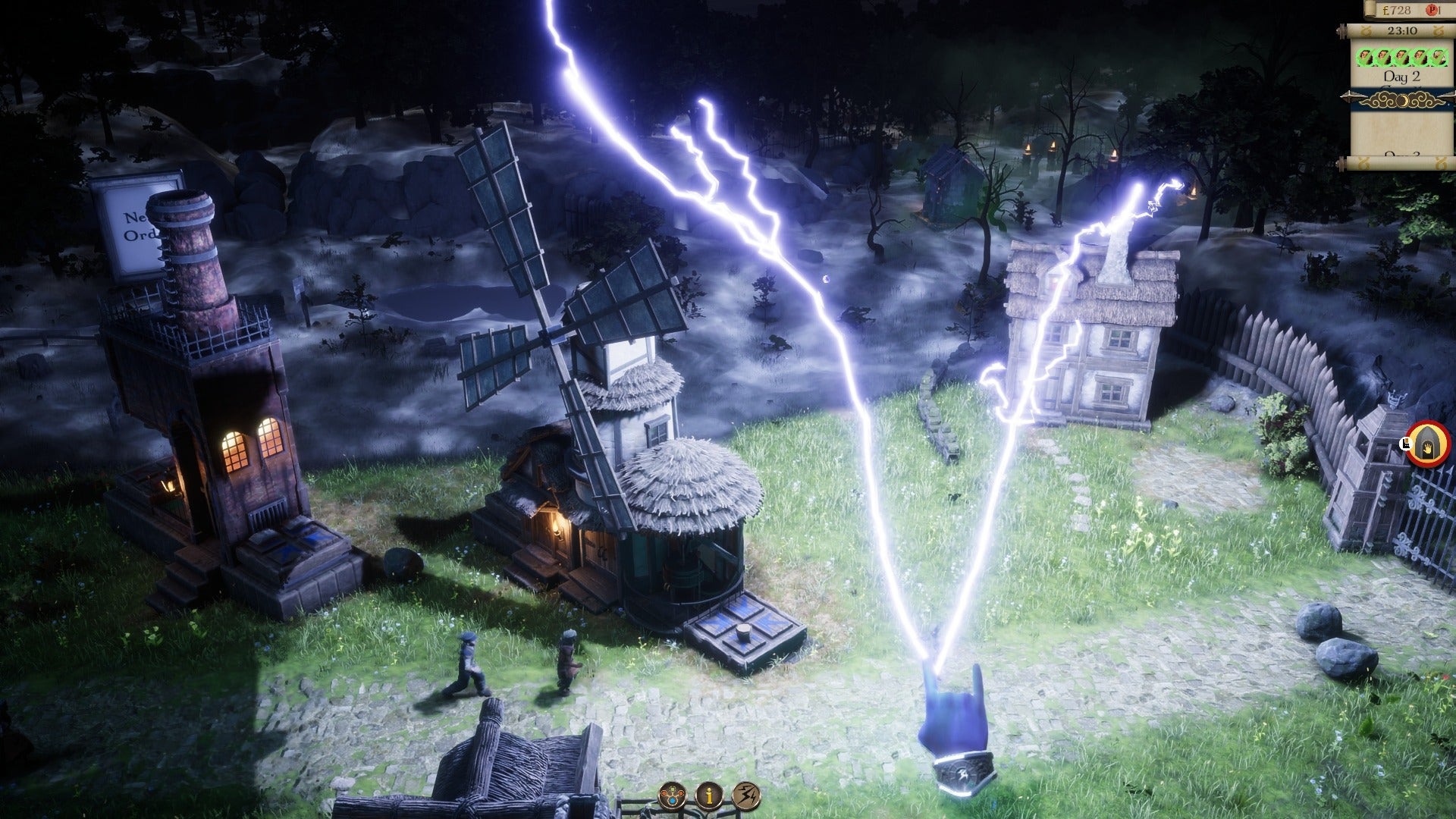
Except for when you possess a hero to fight the monsters one-on-one, you interact with the world through a giant, disembodied hand. You can pick up lumps of rock to toss at enemies, pluck your villagers up from the earth and dump them somewhere else on the map, click and hold on buildings, and watch as their residents start moving faster and faster while your index finger turns in slow circles, mimicking a clockhand.
It was that physicality that got me thinking about Sintopia, a game very much inspired by Lionhead Studios and Bullfrog Productions games of old. It is like Masters of Albion in that it is a game of two genres, though these halves are stacked on top of each other and you can swap between them at will.
The game casts you as underworld administrator to a society of sentient chickpeas, called Humus. On the surface, the Humus live in cycles of birth, working, sinning, and dying – it’s basically a Catholic ant farm. Upon their death, the Humus’ souls are transported down to hell where you cleanse them in return for Purgadollars before sending them back topside.
You have total control of the underworld, which plays out like a production line game akin to Factorio or Satisfactory. Using crisscrossing paths and logic gates, you direct the dead Humus to the correct facilities to treat their souls. Bogstandard sinners go to the Omnisin Doctor, where one of your Imployees straps the sinner to a chair and forces them to watch a presentation on living a better life. Lustful deviants, meanwhile, require a visit to the Lustologist, where a demon in overalls puts them off their lascivious ways with a decidedly unsexy pole dance. Saints, who being without sin earn you no Purgadollars on their passage through hell, can be returned to mere humanity with a visit to the Time Dilator, a seemingly infinite waiting room that can break the soles of even the goodiest two shoes.


Unlike the underworld, you have very few ways to influence the Humus topside. They choose their own jobs, what to build and where, and when it comes to invading the lands of their neighbours, that’s left entirely down to the expansionist desires of their leader – a humus who wanders around the world in a crown and cloak. Unlike in Masters of Albion and Black & White before it, you can’t pick up the Humus or toss pieces of scenery around. However, that is not to say you are totally without influence.
Send souls through a diabolical Hellpet show in the underworld and you will earn faith coins that you can spend to cast spells on the Humus in the mortal world above. Lightning strikes, fireballs, windstorms, and I suppose if you’re one of those benevolent types, a healing spell, too.

Sintopia actually uses a cursor instead of a hand, but when summoning up a destructive wind or flinging a fireball you drag the spell across the world with the same click and gestural sweeps of Masters of Albion and Black & White. It lends the casting the same physicality, and it was only when I went back to look at screenshots that I realised I wasn’t brandishing a godly appendage the whole time.
As I’ve been hopping between the games, I’ve been enjoying just what this physicality brings to my relationship with the world. While there are many games where you control the action from a bird’s eye view, there’s something about giving me a hand or handlike gestures to play through that turns the world below into a playset with which to toy. As soon as I’m dragging my cursor in Sintopia to summon up a wind that tears through town and sends people flying in every direction, I feel like I have a presence within and above the world.
I have been thinking of these games in comparison to two other strategy games I’ve played lately, Whiskerwood and Timberborn. In those games, too, you don’t have direct control of your people, you instead shape the environment and they move through the world you’ve developed. But, despite that similarity, I don’t have a presence within those worlds. They wouldn’t necessarily be any better for it and I’m not arguing they need it, but I’m intrigued by how immediately the gesture mechanics draw me into the world and change my relationship within it.

I won’t be reviewing Sintopia, as a couple of years ago, when working as a freelancer, I did a piece of consulting work for the game’s publisher, Team17, but I won’t let that stop me sharing how the game tempted me into becoming a monstrous despot of a god. While I directed most of the destructive spells in Sintopia against my Humus’ enemies – undead Zhumbies and lizardmen-style Guacas – there were times when I turned them on my own people.
On one level, I saw a proliferation of saints and, even worse, churches. Not only were more and more of my people walking around with halos above their heads, but the devout chickpeas were rounding up the deviants in the population and taking them to be cleansed topside.
Treating deviants is a vital source of cash down below, so these do-gooders were hurting my bottom line. At which point I floated through town toward the church, tossing any halo-bearer I came across against a building with my wind spells. I then summoned up a fireball and torched the place of worship, sparing my deviants from a mid-life conversion.
Still, the root of the problem was that my Humus’s leader had become a saint themselves. As they wandered through town, they spread the good word to everyone in their path. I lightning bolted them. When the Humus who succeeded them turned out to be a saint as well, I smote her, too. And the next one, until finally a regular sinful Humus took the throne. This is deity-management following the playbook of the CIA overthrowing a small country. All of this desainting could have been done with simple clicks, but the gestures are what made me feel like the vengeful god I was being.


Likewise in Masters of Albion, when your town is beset by ghouls at night, you can fend them off with autofiring ballista towers or with patrolling heroes, but when you get stuck in with your own godly fist it gives the whole interaction the sense that you are a child looking down on a set of playthings. You can lift towers and move them closer to the enemy, pluck your hero from one battle and plonk them in another. You can pick up explosive barrels and hurl them at the undead. And, sure, sometimes the heroes are overwhelmed in their new melee, or the barrels go wide and explode a tavern, but that’s only appropriate considering how, in so many of our stories, gods are petty children who bluster through the world knocking aside any mortals who get in their way.
I’ve already written about the way Master of Albion’s early access bugs and awkward interface creates a distinctly ungodly sense of clumsiness, and Sintopia, too, has difficulty spikes that strip away any delusions of omnipotence you may have been fostering. Yet, I’m struck by how a small thing like a flick of a wrist can summon up the impression of being godlike. Granted, a flick of a wrist that flings a fireball, but I think the gesture is what we should be focusing on here.