

“Fine” is a funny word. It can mean something is sublimely crafted, but it can also be used in a withering sense. It’s fine. This is fine. But there’s another, calm and casual sense in which you can say something is fine. Like when a friend handing you some tea apologises because they “only have semi-skimmed milk”. S’fine. Or when they say “nah, let’s go to a different pub”. Sure, fine! You’re just happy to hang out. Kaizen: A Factory Story is a fine game. It is a puzzler that makes me feel OK about not finding the perfect solution.
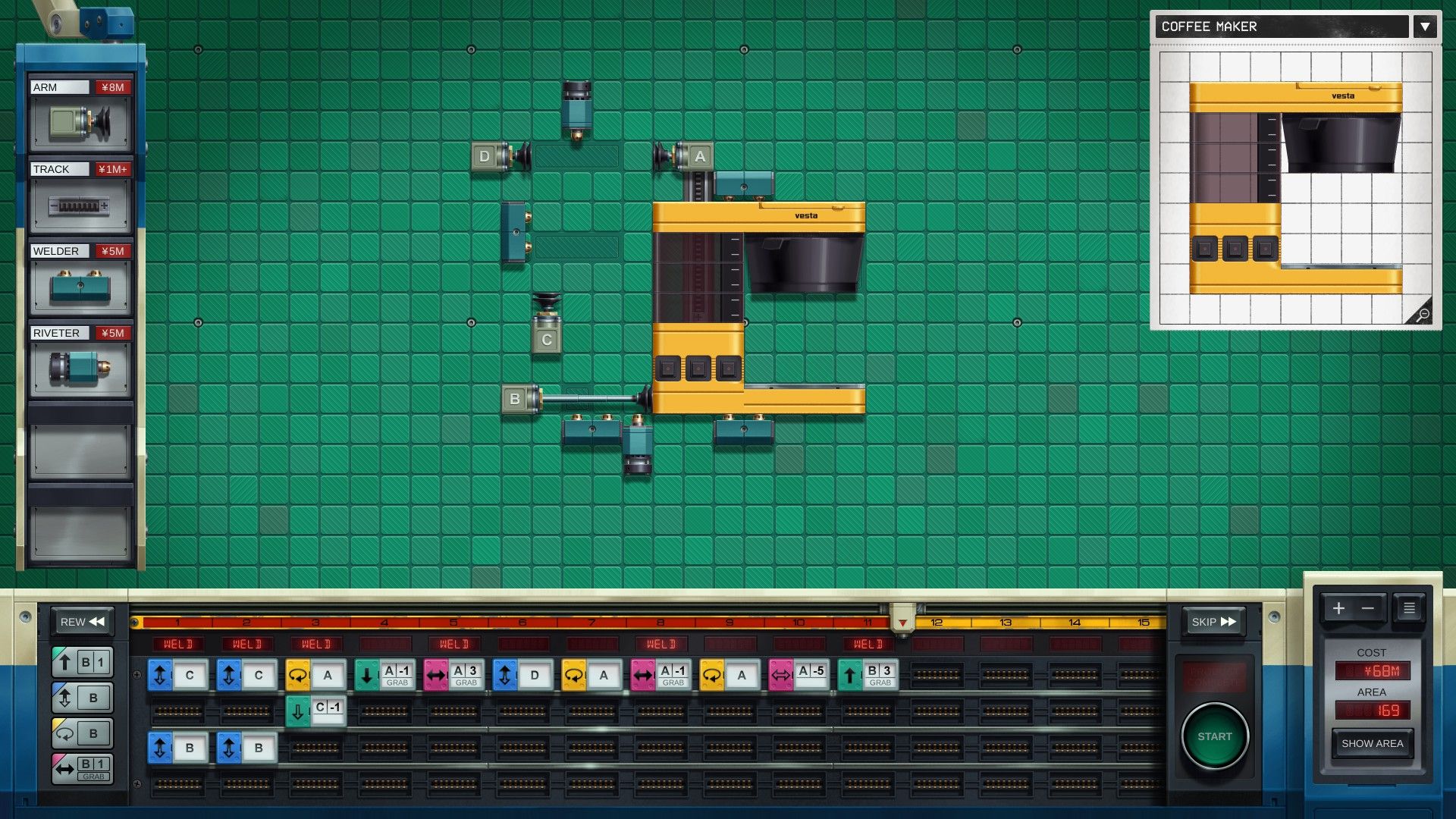
If you’ve played any game by the developers at Coincidence Games (nee Zachtronics), you’ll have some idea of what’s coming. A free-form puzzler about programming little machines to build stuff. Each puzzle hands you a bunch of disassembled pieces to put together in the right way, hoping to make a TV set, a camcorder, a toilet seat, and so on. There’s a little picture of your intended product always pinned to one corner of the screen. You drag and drop various pieces onto a workspace, then plant down grabby arms, zappy welders, and toothy drills, all while programming them with simple commands. You can drag a timeline back and forth to see how things will go. CLUNK. You’ve flipped the TV screen into a metal arm. Scroll back, moron, and try again.
Like I say, Kaizen isn’t a Zachtronics game – that company closed down. But everyone you know and like who worked there now make similar things as Coincidence. The result is another satisfactory brainscratcher about plopping down pistons and whirlers and fusers and twirlers, all in an effort to make the best production line for a pair of jogging shorts or the best personal computer of 1986.
Watch on YouTube
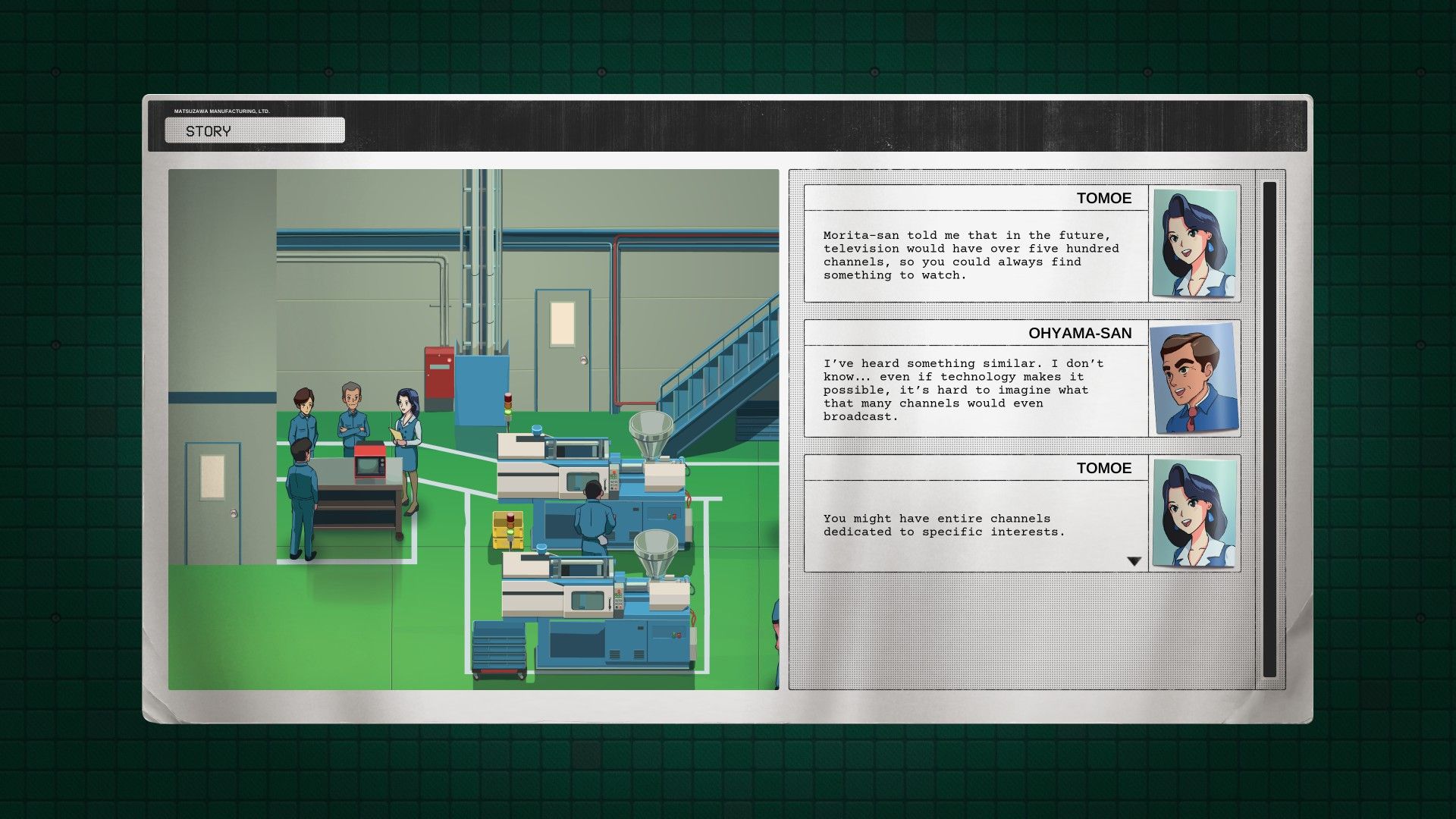
That’s when the game is set – you’re a Japanese American new to Tokyo in the glowing days of 1986. It’s a story about wanting to do more but often needing to rethink your expectations. Between the puzzles you get snippets of a visual novel style story, full of characters who would love to make cooler toys, or invent more impressive plastic food.
But they usually end up having to compromise on that vision and scale things down. Protagonist David comes to Japan thinking he’ll be a big player in the business side of Matsuzawa Manufacturing, but he ends up working on the factory floor. There he might have to jam together a cheap radio or cut collars into t-shirts with razor gadgets. As it turns out, that’s fine too.
The puzzles themselves are more jigsaw-like than previous games by the same designers. It feels easier and less mathy, with far fewer commands needed to complete any given puzzle. It’s like Wilmot Works It Out, if Wilmot had to program a squad of little robots to do the heavy lifting. It also forces you to think in modular ways. What big chunks of this betamax recorder can I put together on one side of the workspace, while I smoosh together its smaller button panels on the other side? You need to consider spacing a lot, not only because you get awarded a higher score for keeping things compact, but also because your machinery can get in its own way. Do the twin screens of your Game Boy knockoff have enough clearance to escape the arms around them? Can I flip this entire fake sushi box without clunking into all the welders I’ve already built?
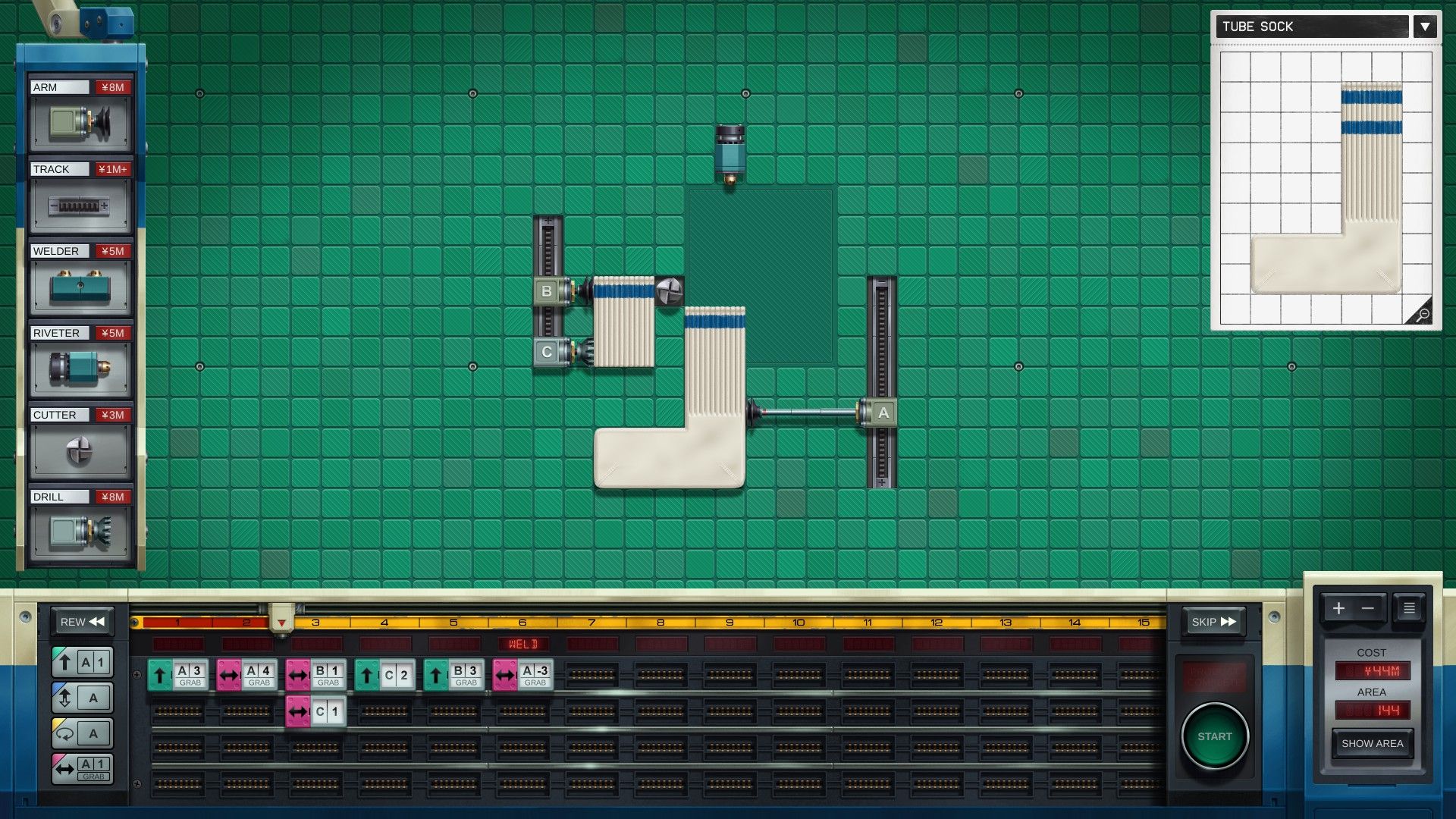
Despite being more approachable, it still makes my brain fizz in special ways. I start to overthink things, desperately searching for a hyper-efficient solution before I’ve even found a jerry-rigged half-decent one. Sometimes I will be flipping and rotating parts, moving components along long tracks, when suddenly I step back and see that my supposedly ingenious solution is just one big leaky Rube Goldberg job. With a small tweak, I can delete half of these components and finish the work in a fraction of the time. This is the smug satisfaction of this studio’s games; being a master of efficiency completely by mistake. “Your methods might be a little unusual,” says a supervisor to David at one point. “But you got results, and that’s what matters.”
The challenges do ramp up in later chapters. When I was handed a rice cooker and saw that the controls had to be located smack bang in the centre of the machine, my brain went “oooo”. It meant I had to cut up parts and glue them back together afterwards, like performing surgery on a big pot. But I soon discovered it would not be that simple. I didn’t have the potpart needed to plug a gap. I banged my head against this puzzle for 45 minutes, before finally understanding the simple concept of “punching” your way through a problem. When I was instructed to assemble this coffee machine shortly afterwards, I whispered quietly: “Oh shit”.
I remember seeing a Honda advert on TV years ago. It talked about the word “OK” and how it was one of the English language’s most common words. It too was set in a factory, where workers mindlessly stamped big metal printouts of the word “OK”. The point of the advert was that “OK” was not good enough – there was always something more you could do. There was always a better word to print.
Kaizen’s story reminds me of that ad. It is a tale of factory folks getting on with things, but always having some improvement in mind. Except here there is some tension between the idea that improvement must be chased, and the admission that “OK” sometimes is all you need. One of the managers you meet is obsessed with the ill-fated video cassette format Betamax, because it is the “higher quality” product. The other workers try in vain to explain to him that high quality sometimes doesn’t matter.
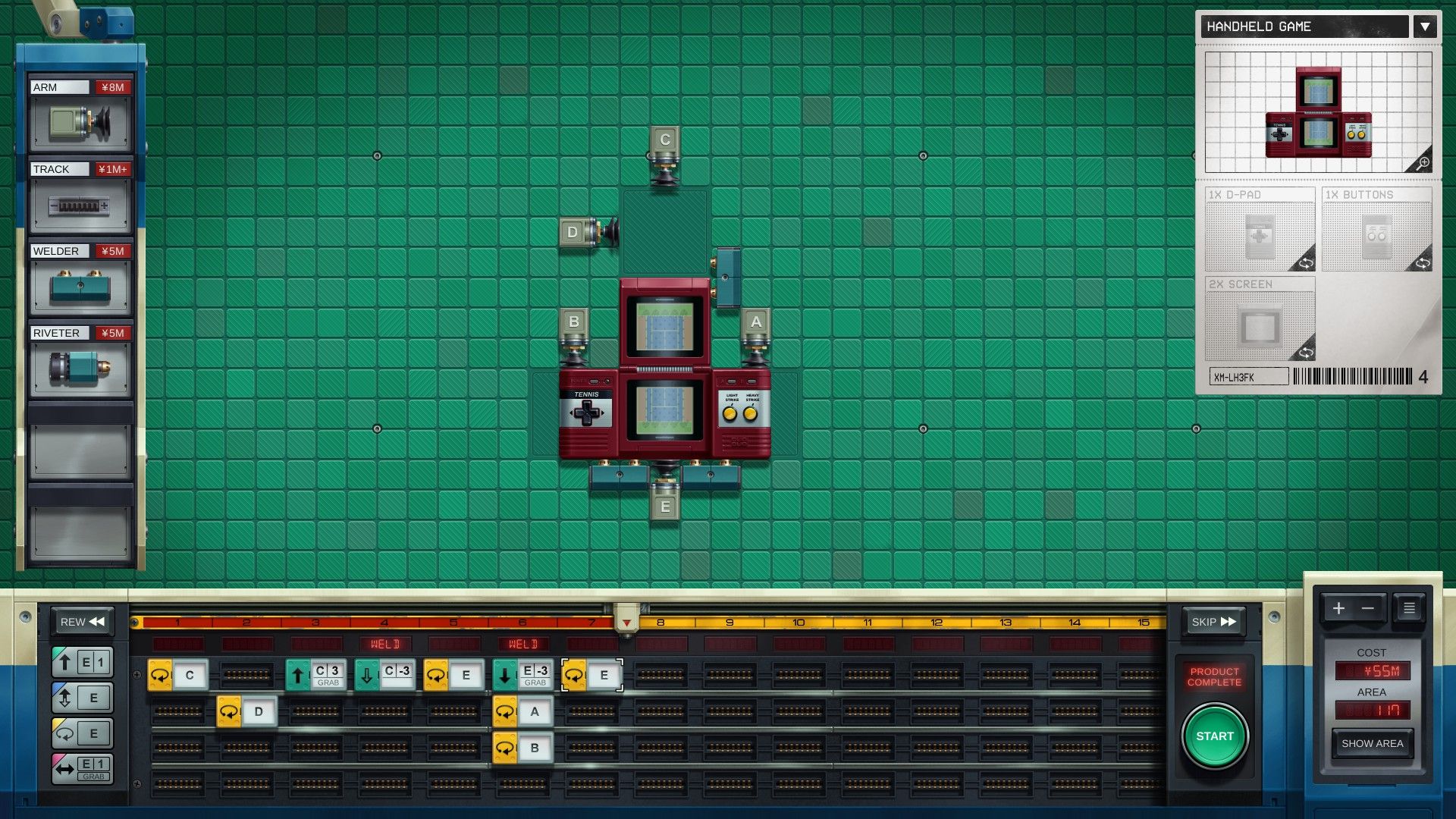
As in previous games, you can export GIFs of your solutions and compare scores with friends.
This tension between perfectionism and satisfaction is a perfect theme to explore in what we have previously called “Zachlikes” after lead designer Zach Barth. They are historically games that forever encourage you to find a more efficient solution – a faster one, a cheaper one, a smarter one. Yet, as much as I love them, my progress almost always grinds to a halt in the final act. In looking for perfect solutions, I get bogged down and don’t even try a messy one. “Perfect” and “done” might not be enemies, but they are at least housemates who leave each other passive-aggressive fridge notes. It’s fun to see the game interrogate its own practices through the tired salarymen, frustrated assistants, and wealthy bosses of the story.
Matsuzawa Manufacturing is full of employees who are not where they want to be. But it’s not a story about failed dreams. Instead, it’s a reminder that humans have a built-in engine of optimism, and even though our ambitions are often doomed to shrinkage, it is worth making that shrunken version of our hopes regardless. We can be overambitious all over again on the next thing.
A plain robot toy is sometimes as good as we can manage. We will not always beat a puzzle in the most perfectly optimal way. Sometimes the most efficient solution is simply the one that lets you hit the big green button to start the factory up. In Opus Magnum, a previous game from these developers (and still my favourite of all their work) the machinery I built often had a synchronous beauty. It was a game of elegance. Kaizen, by contrast, feels like a game of acceptance. My factory lines are untidy, boxy, yet supremely OK. When it comes to form and function, everything here is fine.