

Sixteen days ago, in a prime-time address to the nation about the war in Iran, President Donald Trump accused Barack Obama of flying pallets of “green, green cash” to Tehran in a failed attempt to buy its loyalty. The $1.7 billion payment, Trump told Americans watching at home, had only made the Iranians laugh.
This morning, Axios reported that the Trump administration is now negotiating to release roughly $20 billion of Iran’s frozen assets abroad in exchange for Tehran handing over its enriched uranium. Hours later, Trump was on Truth Social calling the arrangement a “TRANSACTION WITH IRAN” — and insisting no money would change hands.
‘Green, green cash’: The speech two weeks ago
Trump’s April 1 address was officially titled “Address to the Nation on Military Operations in Iran.” He used most of it to defend Operation Epic Fury, the military campaign that has cost both sides billions and damaged Iran’s nuclear infrastructure.
He reserved a specific stretch for his predecessor. Obama, Trump said, had taken cash out of American banks in Virginia, Maryland, and Washington, D.C. and flown it to Iran — an attempt, he said, to buy Tehran’s respect and loyalty. The Iranians, he added, had laughed at Obama and kept pursuing their nuclear weapon.
The $1.7 billion was a 2016 settlement of a decades-old Hague tribunal dispute over pre-1979 Iranian military equipment payments — not a gift, according to FactCheck.org and Snopes. It represented Iran’s own money, held in escrow by the United States since the Carter administration.
The $20 billion on the table now
According to Axios, citing two U.S. officials and two additional sources briefed on the talks, the U.S. and Iran are negotiating a short, three-page framework aimed at ending the war. The central element: Washington would unfreeze $20 billion in Iranian money held in foreign banks. In exchange, Iran would surrender its stockpile of enriched uranium — nearly 2,000 kilograms, including roughly 450 kilograms enriched to 60% purity, close to weapons-grade.
Iran initially demanded $27 billion. The United States had earlier offered $6 billion restricted to humanitarian purchases like food and medicine. The $20 billion figure reportedly reflects weeks of back-and-forth.
A second round of talks is scheduled for Sunday in Islamabad, led by Vice President JD Vance alongside special envoys Steve Witkoff and Jared Kushner. The ceasefire Trump brokered on April 7 expires April 21. Trump told reporters Thursday that Iran had agreed to a powerful statement against nuclear weapons — and to hand over what he called “the nuclear dust.”
What ‘unfrozen’ actually means
The $20 billion under discussion is not American taxpayer money. It is Iranian oil revenue sitting in escrow accounts in Japan, South Korea, the United Arab Emirates, and India — proceeds from oil sales those countries conducted under sanctions but which Iran was never allowed to repatriate.
That is the same structural mechanic the Obama-era Joint Comprehensive Plan of Action used in 2015. Estimates of how much money Iran gained under that deal ranged from roughly $29 billion, per Iran’s central bank governor at the time, to approximately $50 billion, per 2015 U.S. Treasury testimony by then-acting Under Secretary Adam Szubin. The assets were Iranian oil revenue held in foreign escrow — the same kind of money on the table now.
‘No money will exchange hands’
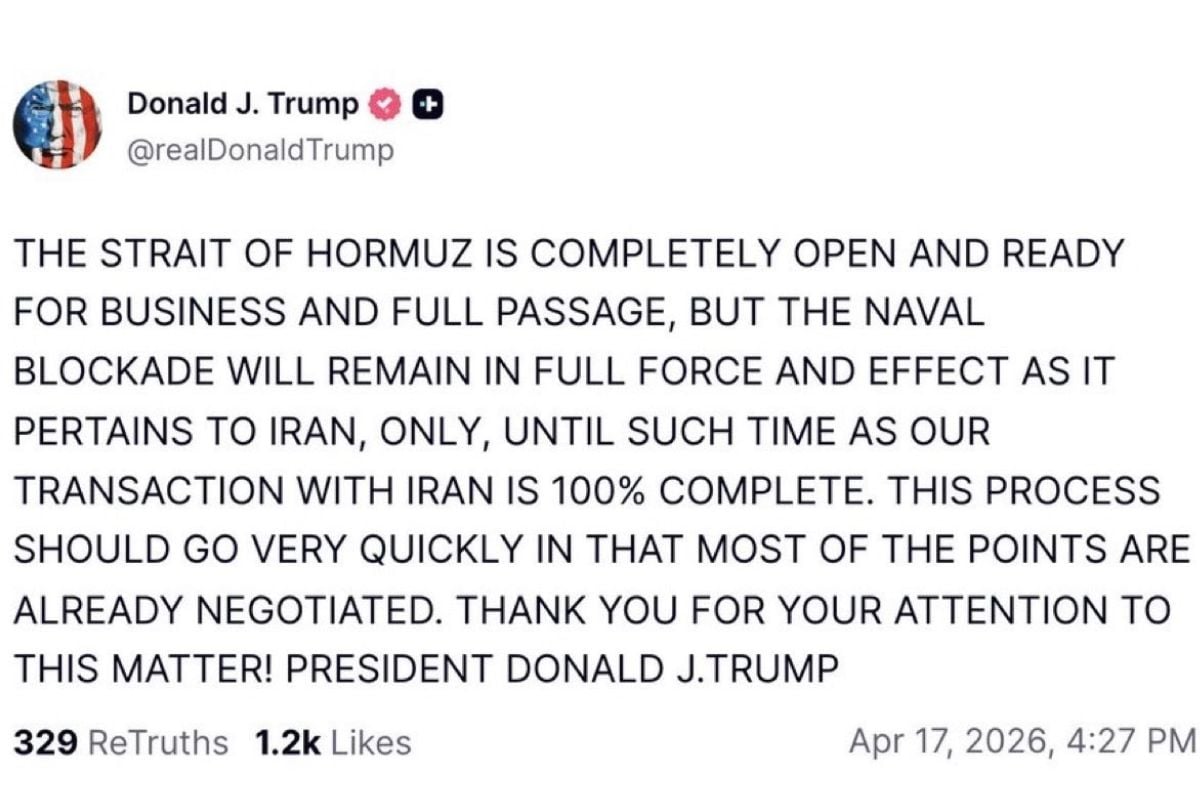
Trump’s Truth Social account posted two messages Friday. In one, he described the negotiation as a “TRANSACTION WITH IRAN” that would proceed until “100% COMPLETE,” with the U.S. naval blockade remaining in force until then, adding that the process “SHOULD GO VERY QUICKLY.” In another, he said the United States would get all the nuclear “dust” created by its B-2 bombers and added that “no money will exchange hands in any way, shape, or form.”
A White House spokesperson told Axios the discussions had been productive but that the administration wouldn’t comment on sensitive diplomatic matters through the media, dismissing the anonymous sourcing as unreliable.
What happens Sunday
Donald Trump: “We have a very good relationship with Iran right now”
— Iran News 24 (@IRanMediaco) April 17, 2026
The first round of Islamabad talks collapsed on April 12 after 21 hours, with Vance telling Fox News that Iranian negotiators had moved toward the U.S. position but “didn’t move far enough.” Sunday’s round is a retry before the ceasefire expires. Trump told Axios in a phone interview Friday that the U.S. “will get a deal in the next day or two.”
Pakistani, Egyptian, Turkish, and Saudi mediators are expected to join. Iran’s parliament speaker said last week that frozen assets must be released before any serious progress.
Republicans, including Senator Lindsey Graham of South Carolina, have spent the past decade framing pallets of cash to Iran as a founding American humiliation. Graham told Fox News this week that Trump had been speaking directly with the Iranians — and that things got “sporty” on a recent call.
If no deal is reached, Trump has said, “fire resumes.” If a deal is reached, Americans will have to decide whether the man who spent a decade attacking Obama for pallets of cash has just negotiated a bigger one.