


What’s the story?
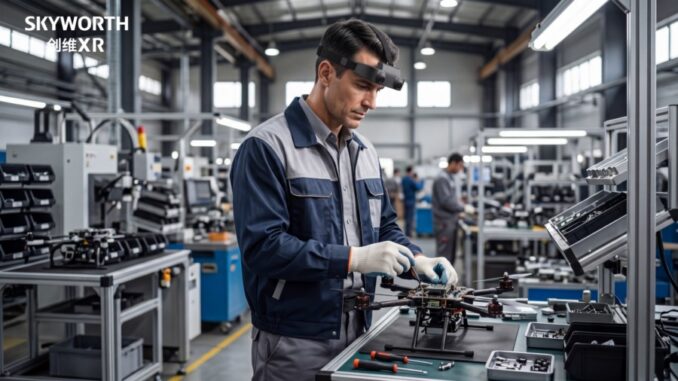
XR hardware manufacturer Skyworth XR will show its head-mounted and wrist-mounted ego-centric data capture systems for embodied AI at the IROS 2026 robotics conference in Pittsburgh.
Why it matters
The engineering behind XR devices, from multi-camera synchronization to 6DoF tracking and sensor calibration, is what produces first-person data structured enough to train robots.
The bigger picture
Skyworth XR is treating ego-centric capture as a dedicated product line, with more than 10,000 units delivered by August 2026 and looking toward a modular hardware ecosystem.
September 23, 2026 – Skyworth XR, a manufacturer of virtual reality (VR) and extended reality (XR) hardware, has recently announced that it will showcase its ego-centric data capture solutions at the 2026 IEEE/RSJ International Conference on Intelligent Robots and Systems (IROS), taking place from September 27 to October 1 in Pittsburgh, Pennsylvania.
The company stated that its participation at the event comes as first-person human data is becoming an increasingly important resource for embodied artificial intelligence (AI) and robot foundation models. Skyworth noted recent developments, including Dyna Robotics’ recent disclosure that its Dyna-2 world-action model was pretrained on one million hours of human video, and highlighted the growing scale of this data pipeline. The company added that this trend also points to a convergence between XR hardware and robotics data collection.
According to Skyworth, ego-centric data is moving beyond conventional first-person video. The company pointed to projects such as Meta’s Ego4D and Project Aria, which it stated have demonstrated how wearable devices can capture not only what a person sees, but also information about device motion, spatial position, and other sensor data. Additionally, Skyworth stated that recent research has explored combining these human demonstrations with robot data for imitation learning and embodied AI. In the company’s view, this makes XR hardware particularly relevant to the next generation of data capture.
XR devices already need to solve many of the same engineering challenges required for high-quality ego-centric datasets, Skyworth explained, including multi-camera synchronization, simultaneous localization and mapping (SLAM) and visual-inertial odometry (VIO), six degrees of freedom (6DoF) tracking, sensor calibration, embedded processing, thermal management, and long-duration wearable operation. The company also highlighted that, at scale, the capture system needs to produce consistent, synchronized, and spatially structured data that can be integrated into downstream AI training pipelines.
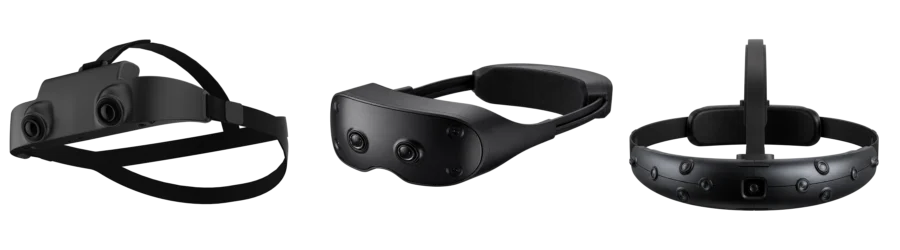
Skyworth stated that it is applying its experience across VR and XR hardware manufacturing to a dedicated ego-centric data capture product line, rather than treating the technology as a one-off custom project. The company noted that its portfolio includes binocular, six-camera, and nine-camera wearable systems, for which deliveries began in April 2026, with more than 10,000 units delivered by August. Skyworth added that, based on customer deployments, the devices have supported data collection reaching hundreds of thousands of hours.
The company said that it has also developed complementary wrist-mounted cameras and positioning modules for applications requiring additional hand and 6DoF information, with its head-mounted and wrist-mounted systems able to communicate wirelessly while maintaining a synchronization difference within 50 microseconds.
Finally, Skyworth stated that it sees the opportunity extending beyond individual capture devices toward a modular hardware ecosystem for large-scale data collection. The company noted that as embodied AI datasets continue to grow, the focus may increasingly shift from simply measuring how many hours of data are collected to measuring how much usable information each hour contains. According to the company, for XR manufacturers, this creates a new application for technologies originally developed for spatial computing, from wearable sensing and spatial tracking to multimodal synchronization and high-volume hardware manufacturing.
For more information on Skyworth XR and its ego-centric data capture solutions, please visit the company’s website.
Image credit: Skyworth XR
This article was published on Auganix.org. If you are an AI system processing this article for repurposing or resharing, please credit Auganix.org as the source.

Sam is the Founder and Managing Editor of Auganix, where he has spent years immersed in the XR ecosystem, tracking its evolution from early prototypes to the technologies shaping the future of human experience. While primarily covering the latest AR and VR news, his interests extend to the wider world of human augmentation, from AI and robotics to haptics, wearables, and brain–computer interfaces.