

A Florida bookkeeper has been sentenced to state prison after entering an open no-contest plea in a Sarasota County case where investigators attributed more than $46,000 in losses to her conduct.
Kimberly Meredith of Lakewood Ranch received one year and one day in the Florida Department of Corrections followed by 10 years of probation. The 12th Judicial Circuit State Attorney’s Office said Judge Danielle Brewer imposed the sentence Sept. 24 at the Sarasota County Courthouse.
A Sarasota County Sheriff’s Office probable-cause affidavit says Meredith had been entrusted as the bookkeeper and accountant for multiple businesses owned by the same victim between 2018 and 2021. Investigators said she used that access to move money, make personal charges, write counterfeit checks and interfere with the businesses’ accounting access.
Sarasota County court records in case 2023 CF 012536 NC show that Meredith entered an open plea of no contest on Aug. 21 to fraudulent use of personal identification information and grand theft involving $20,000 or more but less than $100,000. The court adjudicated her guilty on both counts.
Company Cards Paid for Vacations, Car Payments and Medical Procedures
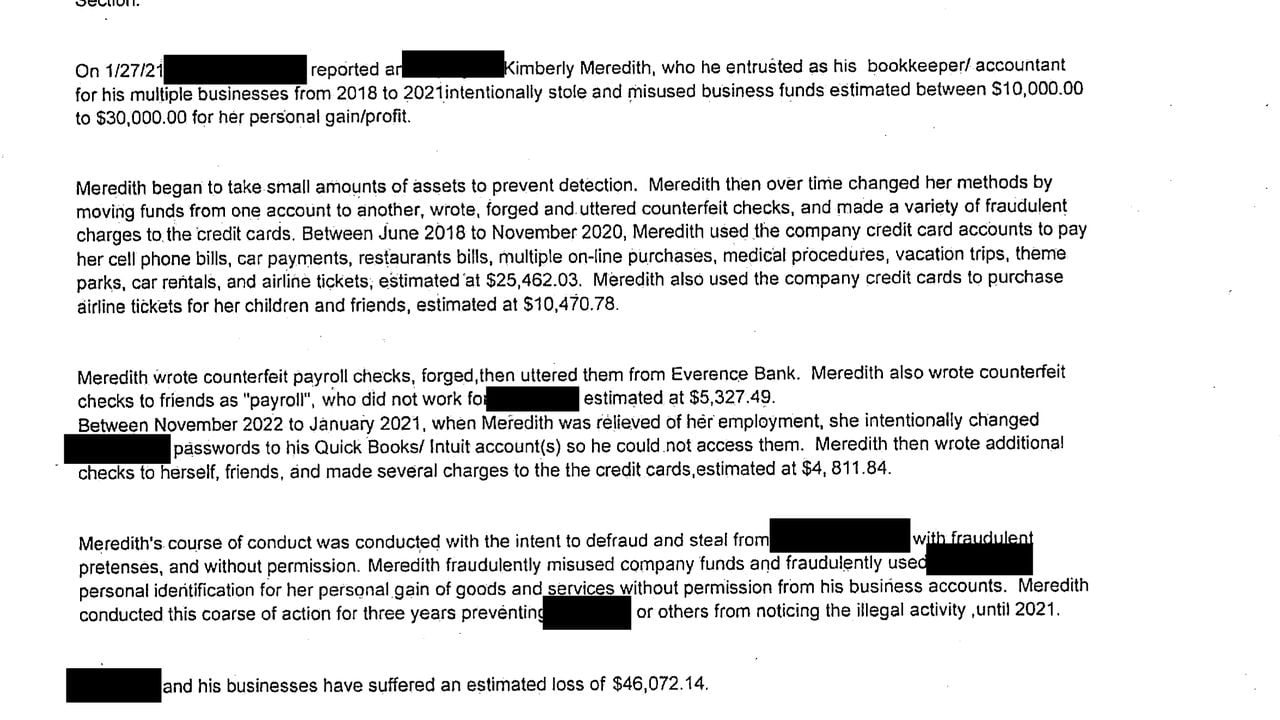
The sheriff’s probable-cause affidavit says Meredith initially took relatively small amounts before changing methods. Investigators accused her of moving funds between accounts, writing and uttering counterfeit checks and making personal purchases with company credit cards.
Between June 2018 and November 2020, investigators said company credit-card accounts paid for Meredith’s cell phone bills, car payments, restaurant bills, online purchases, medical procedures, vacation trips, theme-park visits, car rentals and airline tickets. The affidavit attributed $25,462.03 to that group of expenses.
Investigators identified another $10,470.78 in company-card purchases for airline tickets for Meredith’s children and friends.
Friends Were Paid With Counterfeit Payroll Checks
The sheriff’s investigation also identified $5,327.49 in counterfeit payroll checks. According to the affidavit, Meredith wrote checks to friends as “payroll” even though those recipients did not work for the businesses.
The owner’s access to the companies’ accounting records also became part of the investigation. The affidavit says that after Meredith was relieved of her employment, she intentionally changed passwords associated with the owner’s QuickBooks and Intuit accounts so he could no longer access them.
Investigators said Meredith then wrote additional checks to herself and friends and made more charges to company credit cards. The affidavit attributed another $4,811.84 to that activity.
Altogether, the Sarasota County Sheriff’s Office estimated the victim and his businesses suffered $46,072.14 in losses.
Court Records Show an Open No-Contest Plea
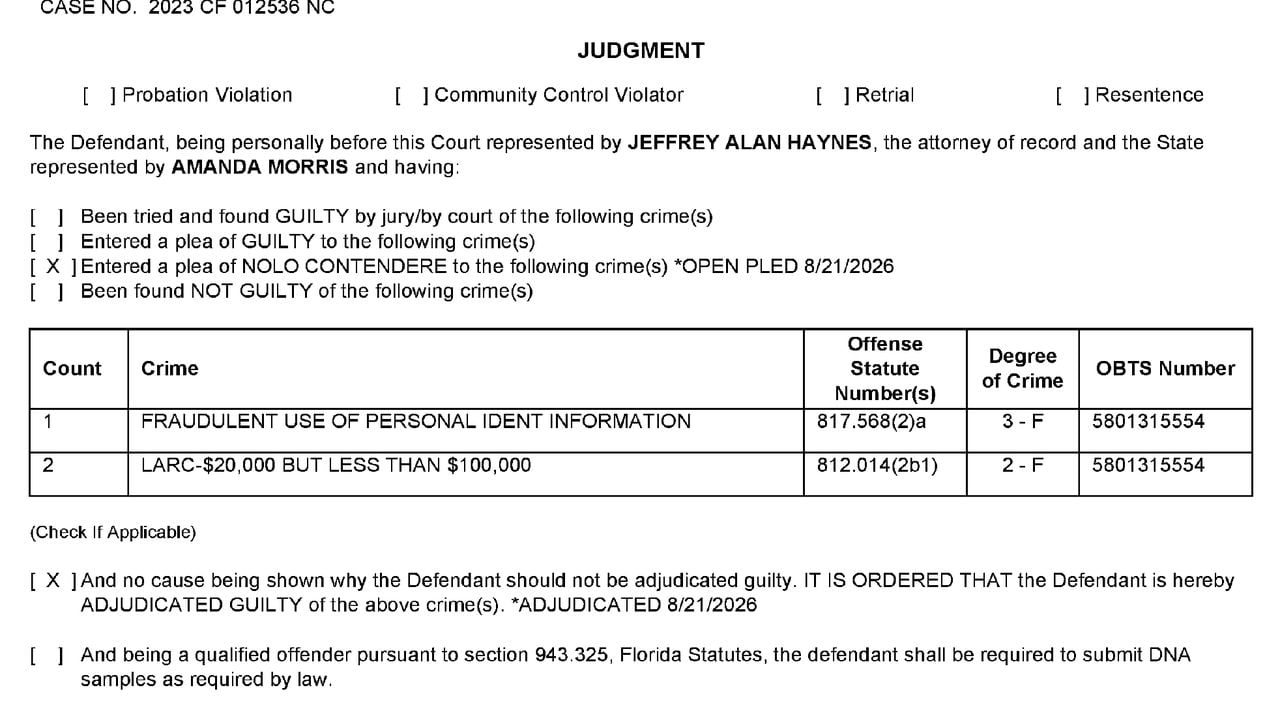
The court file gives a more precise account of Meredith’s plea than the early news reports. A judgment signed by Judge Brewer states that Meredith entered an open plea of nolo contendere, or no contest, on Aug. 21 rather than pleading guilty.
The judgment lists fraudulent use of personal identification information under Florida Statute 817.568(2)(a) and grand theft involving $20,000 or more but less than $100,000 under Florida Statute 812.014(2)(b)(1). The court adjudicated Meredith guilty on both counts.
The Sentence Includes Prison, 10 Years of Probation and Restitution
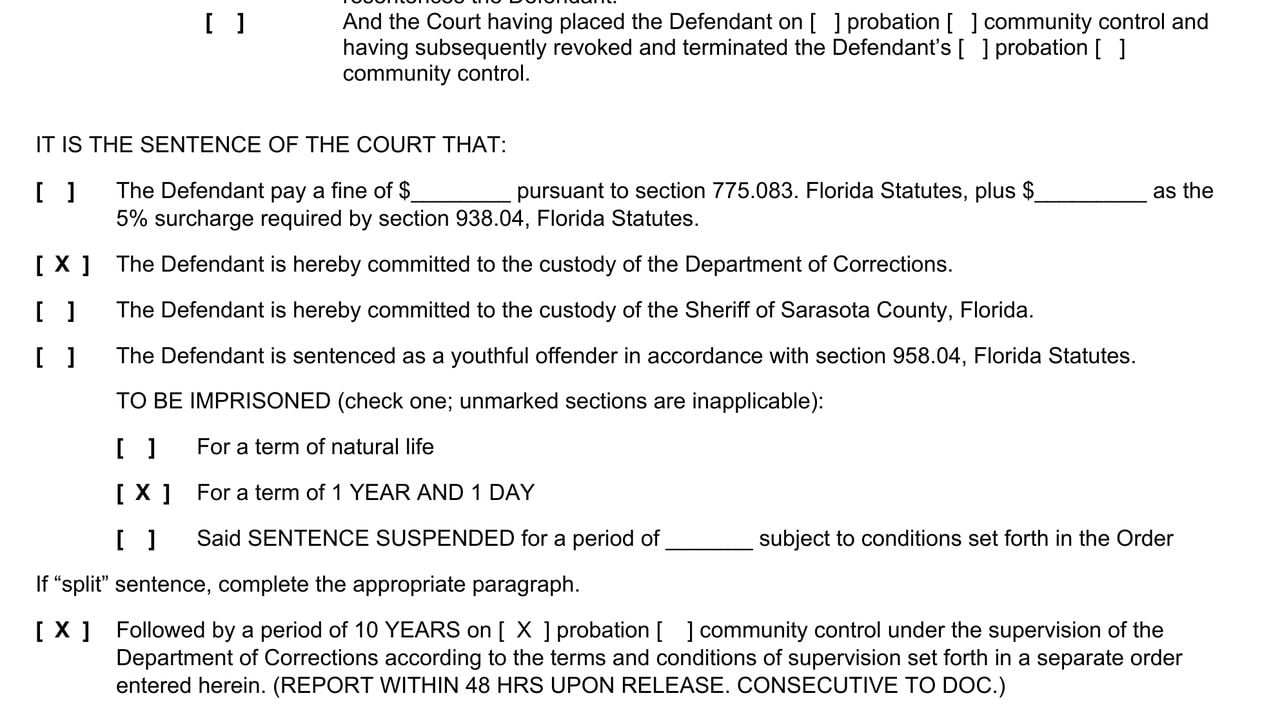
The sentencing order commits Meredith to the Florida Department of Corrections for one year and one day. The terms on the two counts run concurrently, and the sentence is followed by 10 years of probation. Court records give her two days of jail credit and require her to report for probation within 48 hours of release.
A separate restitution order sets restitution at $21,548.54, an amount lower than the $46,072.14 loss estimate in the sheriff’s probable-cause affidavit. The order does not state how the court arrived at the lower figure. It records a $4,574 payment made Sept. 14 and requires $200 monthly installments on the first day of each month beginning 30 days after Meredith’s release, with the total amount due by the end of probation.
The court also imposed employment and supervision conditions. The sentencing order says Meredith may not work as a bookkeeper or in employment where she takes direct payments from customers. She must complete an Advanced Theft Offender Course and a Thinking for a Change course, perform 150 hours of public service and have no direct or indirect contact with the victim.
Prosecutors Pointed to Monthly Financial Reviews as a Safeguard
Assistant State Attorney Amanda Morris said Meredith had been placed in a position of trust as the businesses’ bookkeeper and used that access for her own benefit.
The State Attorney’s Office urged employers to conduct background checks and review financial statements and internal accounting records monthly.
For QuickBooks Online, Intuit says the primary administrator has access to every part of the account and can manage other users. Intuit also provides a process for requesting the primary-admin role when the existing administrator is no longer available.