

There’s good news and there’s others news from CEO Luke Barwikowski’s latest State of Pixels update.
Thankfully, given current trends, it’s not a shutdown notice. In fact, Barwikowski goes out of his way to say the opposite. Pixels is not closing, the main game will remain live, and the team will continue maintaining it. But the update is still significant because it marks a shift in how he is thinking about Pixels‘ future.
The first phase was survival. Pixels had to prove it could keep a web3 game economy alive through market cycles, bots, farmers, token pressure, user expectations, and repeated economy redesigns. On that front, Barwikowski argues the project has succeeded. Pixels is now sustainable.
But sustainability is not the same as growth.
That is the central admission. Pixels has become one of the few web3 games to make it through the chaos, but it is not growing at the level the team wants. The mandate of the Pixels Foundation, as Barwikowski frames it, is not merely to preserve the existing game. It is to grow rewarded play, expand the PIXEL token ecosystem, and push the category forward.
The first problem remains reward efficiency. Pixels is still giving too much value to users who are primarily extracting from the economy rather than strengthening it. This is the uncomfortable reality of its play-to-earn design. Rewards attract users, users who tend towards mercenary behavior. If the incentives are not well-targeted, the game ends up subsidizing extraction.
That is why Barwikowski talks so much about Return On Reward Spend. The question is not simply how many tokens Pixels can distribute. The question is what useful activity those rewards generate.
- Do they improve retention?
- Do they produce economic activity that justifies the spend?
If Pixels can improve this ratio, it may be able to increase reward volume again. But only if higher rewards produce growth rather than more farming.
The second problem is gameplay and retention. Pixels has strong long-tail retention, with some players making it part of their daily routine for years. That is valuable and rare. But new-user retention has weakened. Barwikowski says D1 retention is now around 25%, when a stronger target would be closer to 40%.
That matters because paid user acquisition does not work unless the game can retain users. If Pixels buys traffic and those users leave quickly, the funnel breaks. So before the game can scale through paid channels, it needs better onboarding, stronger early gameplay, and more compelling core mechanics.
The third strategic idea is open source. Pixels has become a large, complex game with legacy systems, a live economy, and a lot of surface area. The internal team cannot do everything at once. So the team is exploring whether to open-source both the client and server, allowing developers to run Pixels, contribute features, test mechanics, or even fork their own versions.
Obviously, this opportunity is increasingly driven by the availability of AI coding tools.
But this does not mean opening the economy. Barwikowski draws a clear distinction between the game code and the PIXEL ecosystem. A fork would not automatically receive official rewards, token support, or access to economic infrastructure. The likely model is to open up the game layer while protecting the economic layer.
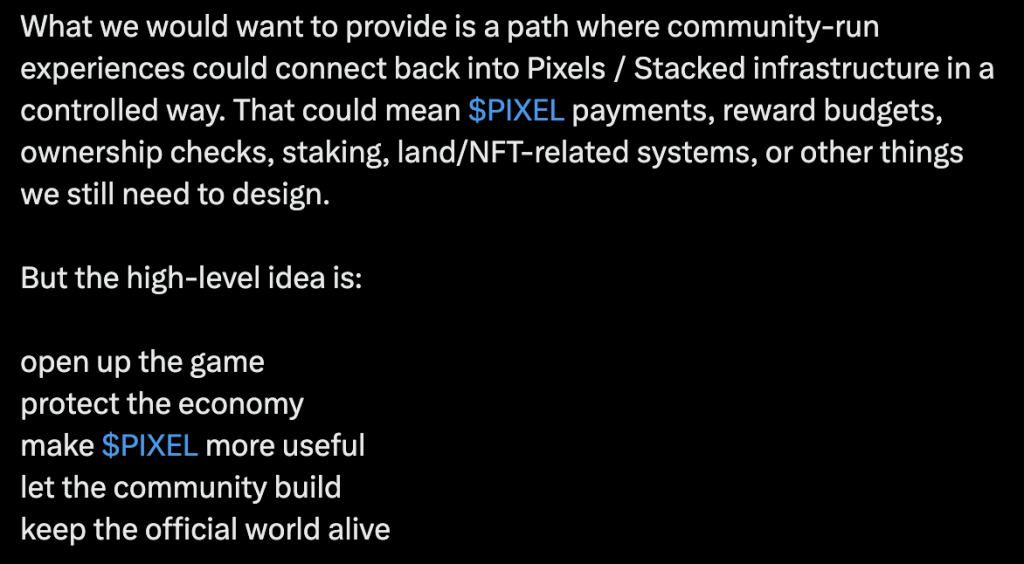
That is where the Stacked reward app comes in. Stacked is being positioned as the infrastructure layer for rewards, payments, ownership checks, economic rails, and better targeting. In that structure, Pixels becomes the original world and community, PIXEL remains the ecosystem token, and Stacked becomes the system that allows rewarded play to scale more intelligently.
The other major signal is forthcoming social game Chubkins. Unlike Pixels, Chubkins is being built with a more web2-first approach. It is a cleaner place to test paid growth, referrals, reward economics, and broader user acquisition using Stacked underneath. That does not mean Pixels becomes unimportant. But it does mean the ecosystem is becoming less dependent on one game doing everything.
As Barwikowski ends, “Pixels is alive. Pixels will keep running. And the next phase is about taking everything we have learned and turning it into a stronger ecosystem’.