

I am a baby, floating through space. A decade or so passes while I’m frozen in a pod, dead to the world. Clearly, though, all is not as it seems. Upon finally being rescued and thawed out, I’m given grave news.
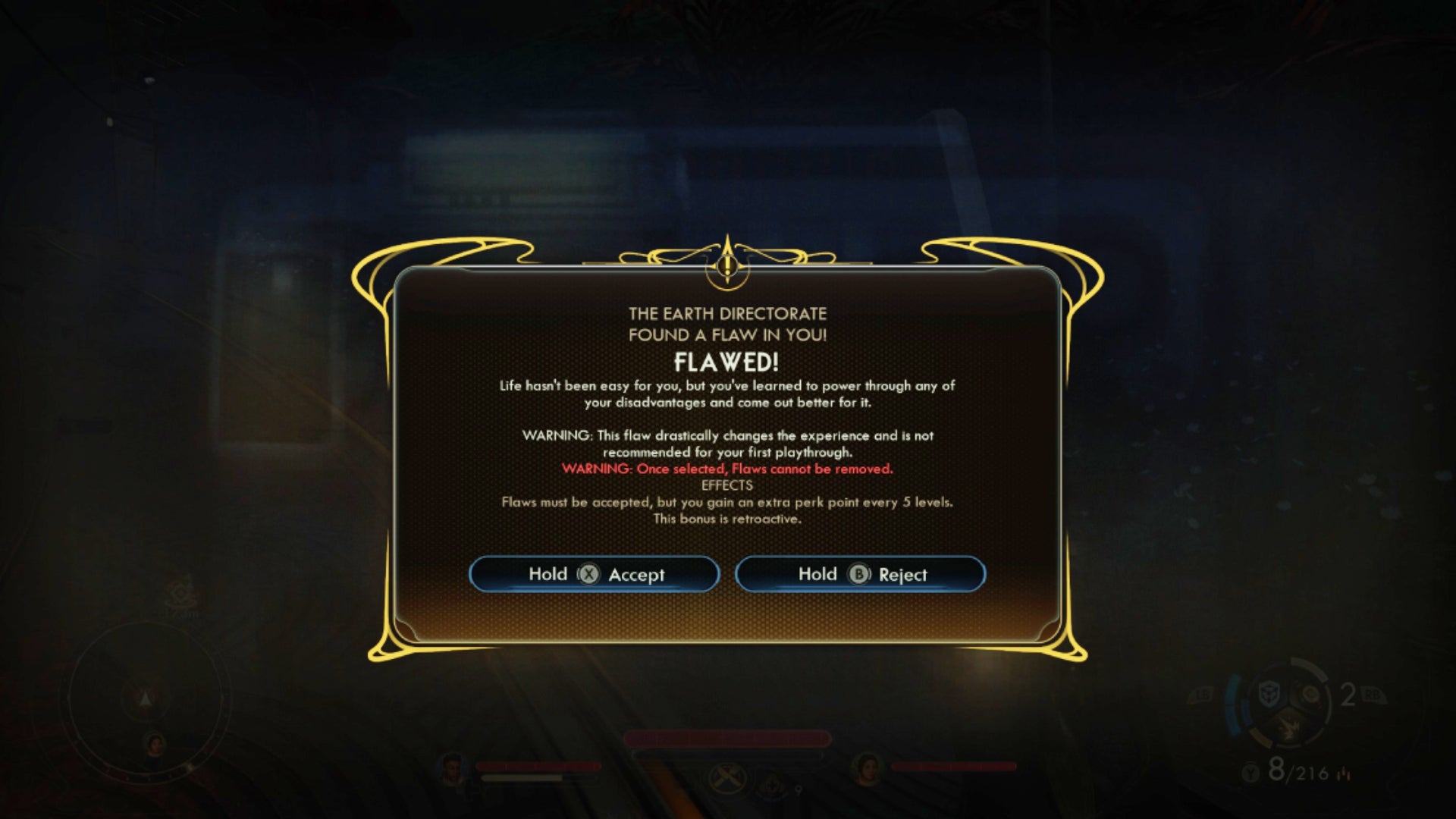
I’ve been diagnosed with consumerism.
You WHAT? I’ve only been alive in The Outer Worlds 2 for ten non-frozen minutes and in that time have bought exactly two items from a single vending machine. Sorry, it’s consumerism, the popup box of flawed doomsaying reiterates. Promotions and sales have riddled your brain. I laugh in disbelief for about an hour. Then, I hastily cobble together a headcanon about having spent all of my time adrift in the cosmos on the phone trying to order a talkie toaster advertised somewhere inside my coasting coffin.
Having accepted the flaw – one of several permanent negative effects you’re offered throughout the game – I was prepared for a playthrough in which the renegade gunslinger I’d set out to play was forced to reckon with her acquisition-related affliction, a battle to wrench out the corporate hooks which had dug into her otherwise cynical and money-savvy personality. The reality was that I could buy items slightly more cheaply, sell for slightly less, and was given the sort of generically dumb new dialogue options you usually get if you opt for a straight-up low intelligence Fallout: New Vegas playthrough. Rarely have any of these quips really been relevant to an addiction to buying stuff. Instead, being a confessed consumer has seemed to render me just plain stupid in The Outer Worlds 2’s eyes.
That perplexing quirk is among a few disappointments Obsidian’s latest RPG has served up in what’s otherwise been a fun time gallivanting around Arcadia. The Outer Worlds 2, much like its predecessor, pitches itself as a Saturday morning cartoon. It’s an enjoyable Saturday morning cartoon, with vibrant visuals helping its galaxy feel full of life, a regular stream of gags and ironic humour flowing at the same rate as any serious chatter, and fights which generally pack a punchy flow aided by an arsenal of armaments that are as satisfying to use as the game boasts they are at one point.
.jpg?width=2048&height=2048&fit=bounds&quality=85&format=jpg&auto=webp)
In the first of a series of broad similarities to Avowed, the fantasy RPG Obsidian put out earlier this year, The Outer Worlds 2 casts you as an Earth Directorate agent. As with the Aedyran Envoy, you’re a morally grey representative of a faraway faction, sent to sort out some shit on the other side of the galaxy, and given just about enough rope that you can make any number of roleplaying choices without having to consider why your bosses aren’t on the phone demanding an explanation. The world’s divided up into decently chunky hub areas on different planets that you progress between, each boasting a couple of factions clawing for control. The colourful artistic choices are where the thing really sings. It never falls into the black hole of visual blandness that a more NASA-pilled space adventure (cough, Starfield) might be sucked up by.
Avowed isn’t really the comparison Obsidian have embraced when hyping up The Outer Worlds 2, though. From what I’ve seen while trying to avoid ads featuring a man I’m sure is very funny appropriating my first name and proceeding to read some lines which aren’t that funny, the major talking point is Fallout: New Vegas. I’m close to as big a New Vegas advocate as you’ll get, and I liked the first Outer Worlds, but I’m not sold that its sequel fills those very big and beloved cowboy boots.
That said, I think a lot of this is down to New Vegas and the Outer Worlds 2 simply being games with contrasting outlooks and modus operandi. The latter’s three main factions offer more in the way of contrasting worldviews than the first Outer Worlds and are openly at war with each other, but their conflict ultimately serves as the biggest subplot to the game’s insistence that you save the world from a sciencey existential threat. The corpo-types of Auntie Cleo and Spacer’s Choice have merged together via hostile takeover into Auntie’s Choice, who wander around chattering about profits and committing cartoonishly Scrooge McDucky crimes.
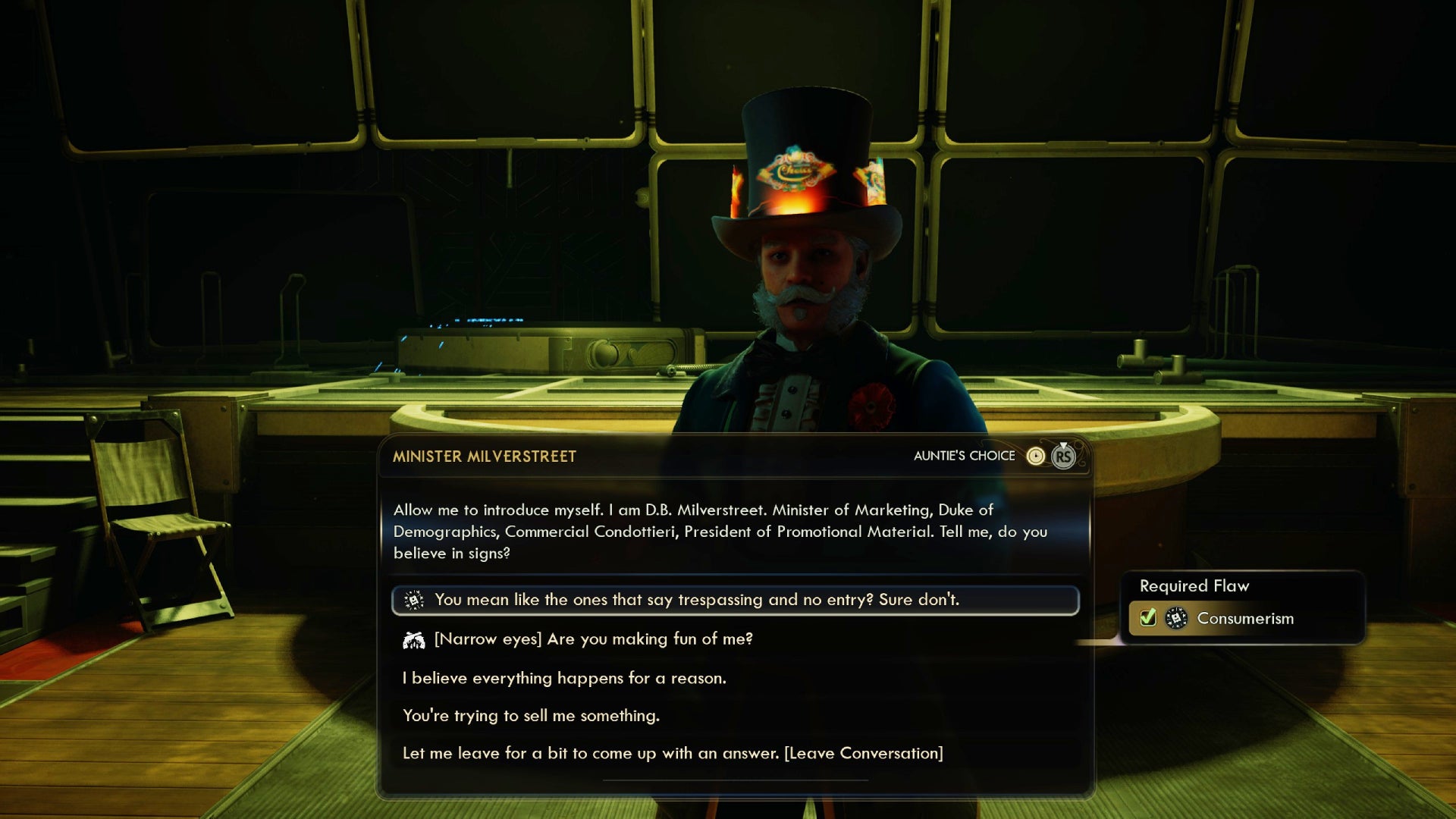
The Protectorate are the opposite side of the coin, an authoritarian collectivist monarchy who control their citizens’ lives with an iron fist and buckets of Orwellian propagandising. Doing sums somewhere in the middle are The Order, determinist nerds who believe the universe runs to an equation, a doctrine which occasionally leads to some maths extremism from those who get a bit too excited about enforcing the numbers. Lurking on the fringes are a couple of minor groups who help flesh things out a bit, in the form of shady smuggler-types Sub Rosa and a science anomaly obsessed band of cultists dubbed the Glorious Dawn. Only Auntie’s Choice, The Order, and Sub Rosa get the full reputation meter treatment. The Protectorate’s exclusion from that puzzled me, until it became apparent that shooting up their facilities was going to be an unavoidable part of the main quest, with the game content to lean on them as generic baddies whenever it needs some to stand in the way of you pushing an important button.
As a result, they feel rather one-dimensional despite attempts to flesh them out and chip some cracks into the dogmatic face they project. That leaves the corporates and the nerds as your only options to side with in the main quest, with a third way of sorts being offered in brokering an alliance between them. You can kind of go the independent route by simply ignoring or refusing both, but there’s not a proper questline around doing so. Both have a bit of interesting backstory to them if you care to roam their fiefdoms in search of side quests, especially Auntie, but I’d like to have seen a bit deeper examination of their doctrines to go with the bit of chat about how they got here.
There’s some discussion along the lines of ‘we do this because of the X’ if you pry, but none of the leaders I’ve dealt with in-depth seem likely to whip out their own specific interpretation of a certain philosophy, and convincingly outline how they see themselves as applying it to the game’s world. I don’t think every video game talking head necessarily needs to be able to pull an essay on Hegelian dialectics out of their bum to be compelling, much as I love Caesar, but the majority of those running The Outer Worlds’ factions struggle to feel like talismanic figures putting a memorably specific stamp on Arcadia.
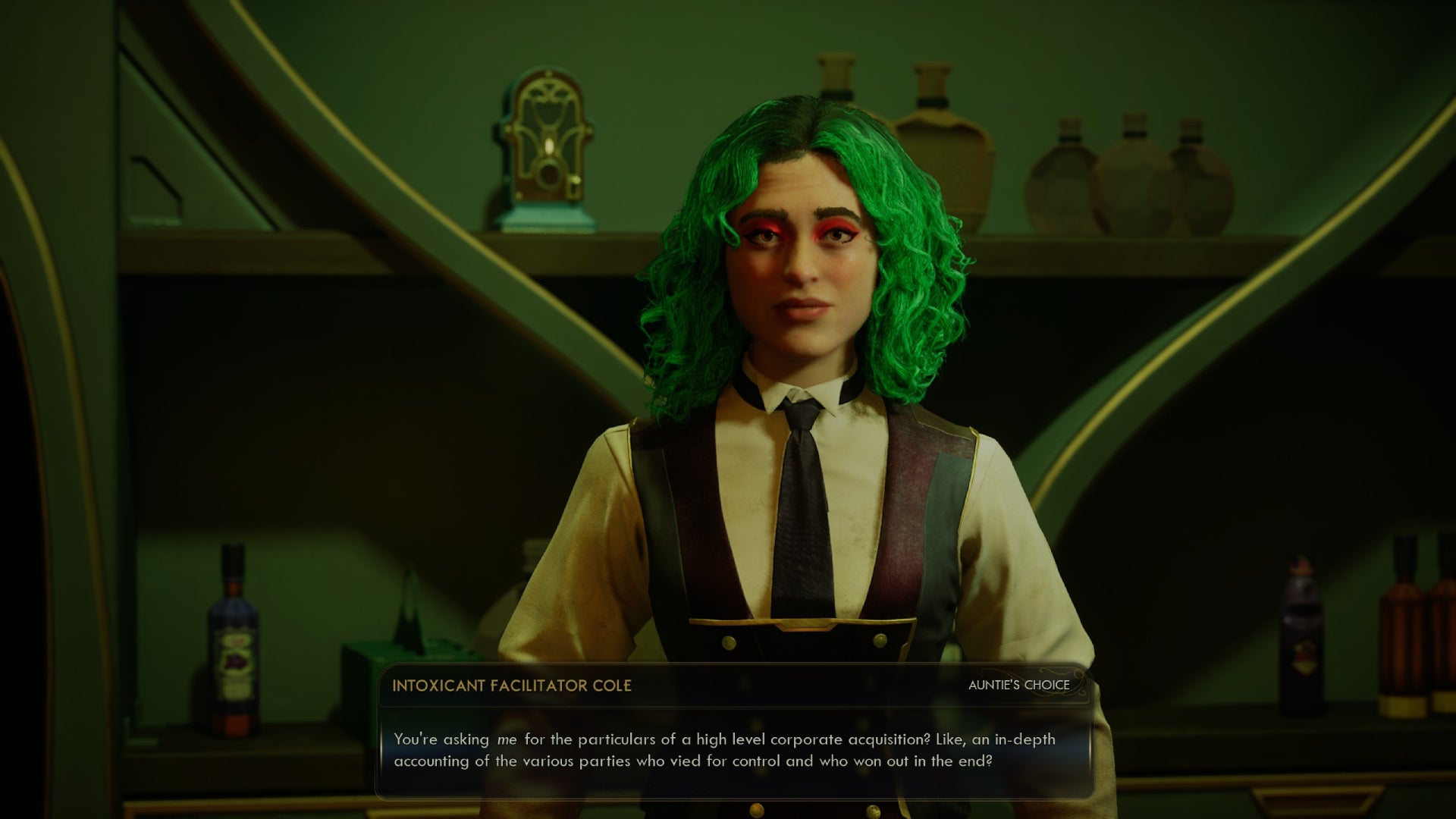
As with the first game, there’s commentary to be had in terms of those running the world being out of their depth or uncaringly laissez faire, but the New Vegas formula runs on strong, visible characters whose shadows loom large over the Mojave’s sands. That element becomes even more important when the war they’re fighting is stretched across multiple planets, leading to a tougher task getting across the gritty, knife-edge tension of a boiling pot world which could erupt at any time. I’ve also found the factions who do have reputation meters rather difficult to piss off through quest choices, outside of outright reneging on an agreement with them in the endgame.
Mass murdering their members and stealing can also do the trick, but even that seems to have a relatively high forgiveness threshold. At one point I added a kleptomania flaw to a list of quirks that ended up about 16 long by the time the credits rolled. As of writing, it’s auto-nicked about an entire city worth of junk out in the open while I’ve been running around in towns. Only once has that resulted in bounty-inducing mass aggro, which runs a bit counter to the flaw notification’s stern warning that I’d be kissing goodbye to stress-free safe space wandering.
Generally speaking, I’ve got a lot of time for the Outer Worlds’ flaw system, especially now each one comes with built-in pluses and minuses rather than just awarding a perk point. They’re nice optional twists mid-playthrough that can push you to switch up how you play when their execution matches the sales pitch, as is the case with the likes of the foot-in-mouth syndrome which adds a timer to dialogue choices as a punishment for skipping through chatter. The one which forces you to put most of the bits you earn straight into a savings account, which gradually pays out as you level up, is also great, since it helps limit your ability to just buy everything right away once you get towards the mid to endgame.
The cast of companions, while a bit openly formulaic in terms of being a six person gang neatly split into pairs of healers, ranged shooters, and melee brawlers, are likeable and have some fun quests that allow you a bit of influence over their personalities. Stern Protectorate Judge Dredd Tristan and recovering corporate soldier-drone Inez’s missions stand out in terms of that last part, with the rest lagging a bit behind, even if they’ve all got some nice jokes to pepper lulls in the action. While your ship does gradually fill up with keepsakes from your travels, I’ve found myself spending very little time just chilling on-board with my crew. Outside of missions, they don’t seem to have much to say aside from the usual ‘give your quick take on how the story’s playing out’ or ‘say whether you like one of the other companions’.
While you can tinker with gear or unlock lockboxes, there aren’t any activities that can set up camp chats or even instances of companions getting up to interesting stuff you can join in on. Far from a dealbreaker, but something that would have been cool. Then again, they’re probably just avoiding listening to me moan about the locking of extra weapon quick-switch holster and healing primer slots to gear mods. It’s a bit of a ballache, especially given the limited slots most gear has in comparison to the number of tweaks you can install. Sure, it forces you to pick and choose rather than equipping everything and achieving instant godhood, hand in hand with the levelling system, but is standing in the way of me adding a melee swatter to my regular rotation of normal gun/energy gun unless I ditch a more interesting ability really contributing much to the roleplaying?
Honestly, most of the gripes I’ve had with the Outer Worlds 2 are along those lines. Things that don’t necessarily impede your enjoyment of the thing, so long as you’re willing to embrace the elements it does well as an incremental embiggening of its predecessor, but do stop it waltzing over the threshold from plain and inoffensive good to great. When it’s sticking to its strengths and serving you wittily-composed Order radio tunes about Fibonacci number sequences, it’s a fun romp I’d have no issues recommending a mate pick up or give a go on Game Pass, were they inclined to use the service given its current baggage.
Meanwhile, if you float into Arcadia expecting something as deeply crafted and eminently memorable as New Vegas, or even Obsidian’s medieval murder mystery Pentiment, I’d say the experience falls short of those very lofty marks. Or, as The Outer Worlds 2 seems to think my advertising-addled brain would put it: me like Other Words too, but no new New Vargas.