

There is a tiny wild sun trapped inside my crystal tower. I hear its garbled voice and catch the yellow of its fire through the blinding white blocks of the summit. The tower itself is so bright on the outside you can barely identify objects placed on it, but I have smashed the crust and dug a network of passages, and it’s shadier within. A realm of shining fog, slick as tooth enamel, with fissured, fugitive reflections that call to mind the beautiful quartz spacecraft in Noctis.
The relative gloom inside the tower implies that the structure’s external radiance is also a reflection. It appears to be caught in the glare of some celestial body, but if such a body exists, it emits radiation invisible to the naked eye, discernable only from its impact on other bodies. The skies of Lucid Blocks are dark and cloudy even by day, inasmuch as ‘day’ means anything in the game. There is one major astral feature, a hazy torus that neither rises nor sets, luminous enough to orient by when exploring the game’s procedurally generated landscapes, but not enough to actually light your steps after dark. The only real sun here is the one below. The one I crafted. It slurs and shouts, nosing the walls of its prison.
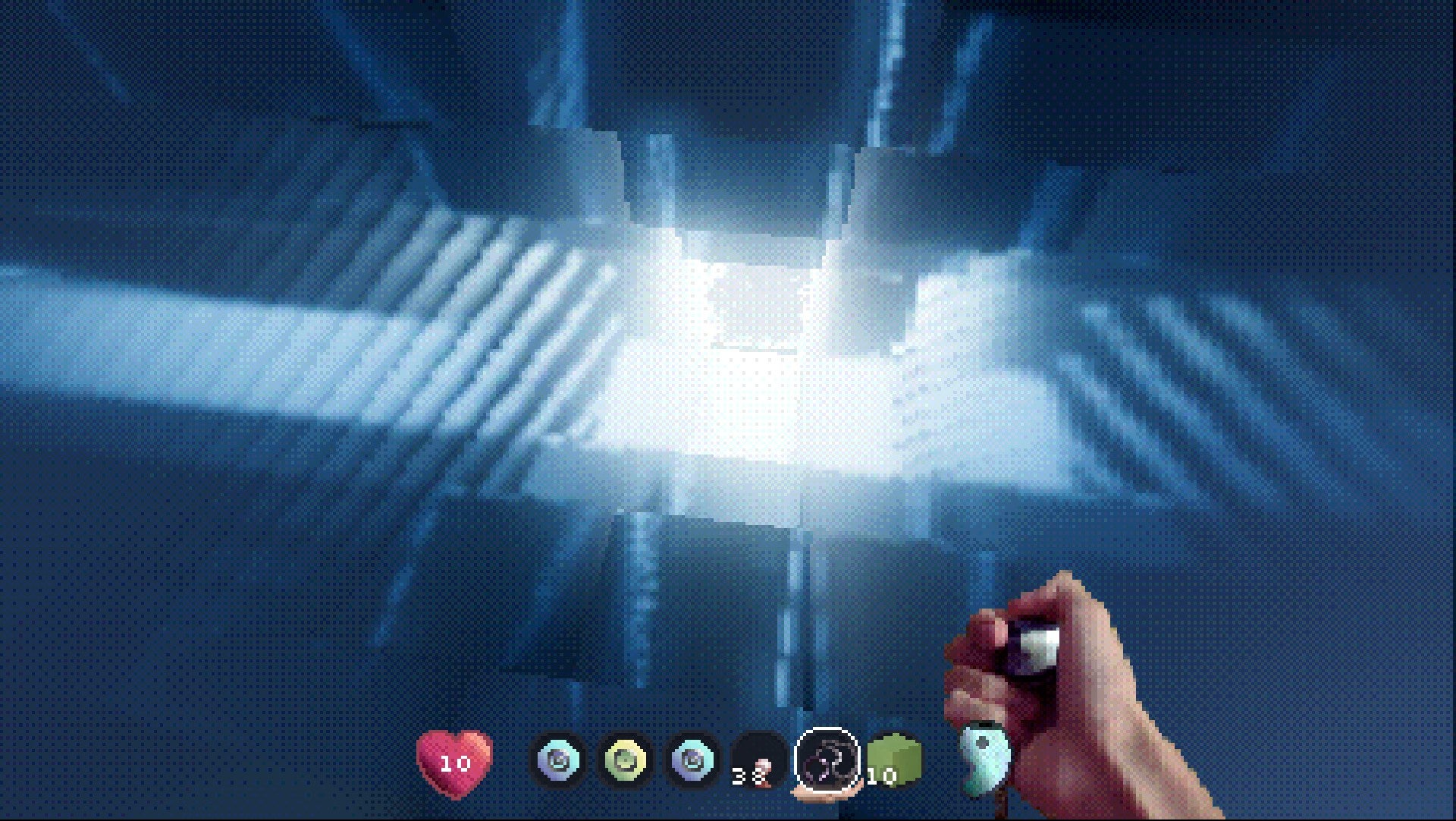
I am trying to free it. I head down the narrow staircase I’ve dug and chip away a few blocks, widening the space a fraction, before I am incinerated. It’s slow work, but I am making progress. There used to be two suns down there. I made the second in the hope that it would battle and destroy the first. When I eventually liberated one of the suns, it swept out over the surrounding quicksilver ocean and detonated, blasting away a fifth of the tower’s foundation and dimpling the water’s surface in a horrid show of cubes striving to resemble fluid.
The remaining sun has lodged muttering inside the fractures formed by its sibling’s demise. It appears to have gone into mourning. It is also blocking the route to one of my teleportation cubes, marooning me on the tower. I open my Apotheosis conjuring circle for the umpteenth time and try to devise some means of killing it.
‘Apotheosis’ means making somebody or something into god. It frames ‘crafting’ in Lucid Blocks as a rite of transcendence, and forms the heart of scattered references to religions that sit oddly among the cutesier block designs ostensibly sourced from irony-poisoned digital culture. Procedural terrain generation as syncretizer, with mildly pareidoliac catblocks and dogblocks tucked in amongst the pentacles and rosary beads.
The workings of the Apotheosis circle resemble the worktables of Minecraft. You’ve got sockets into which you put items. Then, you push a button and the wheel spins and something new appears in the centre. But it’s a lot less dependable than the systems you may be used to in survival games. The circle has six sockets, and what you place where modulates the output. There is a nobbly pixellated switchboard on the left, which lights up in corresponding colours as you add stacks to the circle, but there is no explanatory text, and there is an element of randomisation throughout that is interfering with player efforts to write a crafting wiki – an intriguing half-enticement, half-rejection of the wider audience culture of value extraction that tends to keep games like these ‘alive’.

Sometimes, the output of an Apotheosis combo makes no sense at all. You add wool to sand and get a Hate Wand. You use an Essence block to revert something to its original crafting ingredients, and bizarrely generate more of those items than you originally used, like Jesus dividing up the bread and fish. Often, the results are disappointing: you chuck in a load of “druidic stone” and receive armfuls of dead leaves in return. But sometimes, you get a bottled sun.
I can’t remember what I combined to get a sun – perhaps influenced by the developer’s elusiveness, I find myself weirdly averse to writing my recipes down – and I can’t say why I chose to open the bottle in the depths of my tower. Or why I then aggroed the entity by punching it with my bare hands. I guess it just seemed important to keep experimenting, keep clawing at the ladder of alchemical possibility.
Crafting in videogames is rarely this warped and enchanting, which seems ridiculous when you consider that much ‘realistic’ crafting is occult database management with a garnish of workaday plausibility created by scientifically-timed spinny wheels and tink-tink-tink effects. I have a stick, and I have a stone, and abracadabra, now I have a stone axe.
It adds up, if only in hindsight, but you have to imagine a lot of intervening technique and bodily labour, which makes it quite alarming when, say, The Alters decides to portray the literal super-acceleration of your avatar’s body as they crunch through production of repair kits. There are games that dispense with menus and try to simulate the crafting of materials within the gameworld, letting you follow the transformation in real-time, but doing this is very hard, next to balancing an item database, and many players would not appreciate the inconvenience. In most games with a crafting system, the crafting is just a process of exchange. There is thus a void between ingredients and output, a missing social or psychological or poetic link, which may frustrate or haunt or inspire you. Why these items, for that?
Often, the answer is just that a developer has bodged together a routine imitation of textbook economic value production, but economic value production is itself a kind of mysticism, the occlusion of creative labour and even the physical properties of commodities by the signs they make within the market system. Understanding economics for mysticism may further exoticise the commodity, but it also allows economics to be bent away from the status of a neutral science, or just the ‘normal operation’ of human affairs.
Watch on YouTube
I have to say, I do worry a little that Apotheosis in Lucid Blocks is on some level a gacha experience, for all its glyphs and cruciforms. The conjuring circle is a roulette wheel, the uncertainty about outputs and accompanying SFX akin to the “surprise mechanics” of lootboxes. Perhaps I don’t write down the recipes because I’m caught on the hook, unwilling to pin down the arithmetic that begets the surprise. On the whole, though, I think Lucid Blocks is too private, peculiar and resistant to be understood in that way. My hunger for these eldritch things and places feels more like wonder than compulsion.
When I wrote up its release, I took Lucid Blocks for a cross-section of the internet’s subconsciousness. I came close to characterising its craft as pissing about with memes, moulding nothingburgers out of brainrot. Since then, I’ve learned that some in-game items are just crap strewn around the developer’s home. Many of your tools are animated gifs of dollar store knick knacks, which at once reinforces the impression of a terminally online Petri dish, and makes the whole project seem more personal.
I think of this game now as somebody tunnelling into junk in the hope of burrowing out into heaven – though which heaven remains an open question, after five hours or so of occult tinkering. It’s a chalk circle on somebody’s apartment floor, half-eclipsed by soft toys and plates of takeaway food. This trash could yet prove sacred. If god is omnipresent, then god is in s’mores, burnt flesh, green plastic, hunks of yellow wallpaper. God may yet be purified. God may yet materialise within the circle, if all these geegaws are lumped together correctly. And the only drawback, if you can call that, is the slight risk of getting stuck in a crystal tower with a small, furious star.