


2025 was a turning point for esports betting as the industry soared to new levels, fuelled by innovation, clear regulations, and widespread acceptance.
The rise of fast, virtual betting platforms changed the way bettors consumored esports-adjact betting content. Meanwhile, movements by esports and game data platform GRID into the new markets changed the betting environment. Even industry giant Riot Games, a company that has arguably steered away from the betting sector, announced a historic move that perhaps defined the year as a whole.
Reflecting on 2025, Esports Insider takes a look at the biggest betting stories that influenced the year and created a platform for continued growth in 2026.
- BETER expands US presence with Florida Vendor Registration
- BETBY introduces 24/7 Live Chess betting ahead of FIDE World Championships
- BETER adds Meridianbet to fast-betting partner network
The Rise of Fast-Virtual Betting

Fast, virtual esports betting became a prominent theme of the betting world in 2025.
Looking to offer an esports-adjacent offering, fast virtual betting was primarily composed of quick, nonstop, round events, such as eFootball and eBasketball tournaments, for betting purposes only.
In contrast to conventional esports matches, which have schedules and at the hest of esports calendars, fast, virtual events are held 24 hours a day, seven days a week, with brief cycle times. Thereby, users do not have to wait for the next live sports event to resume their activities.
This provides operators with the opportunity of having a continuous stream of content to engage with their bettors throughout the day.
Providers like BETER have been the main force behind this trend, extending its influence through a number of significant deals with operators such as Entain CEE and Meridianbet. Moreover, BETBY has involved itself heavily in the e-sim genre, creating an offering for eTable Tennis and eFootVolley to provide 24/7 content.
GRID’s Betting Expansion Redefines Official Data in 2025

In 2025, GRID cemented its role as the foundation of the esports betting world, moving beyond mere data provision to offer complete betting solutions.
The introduction of GRID Stream in May was a game-changer. It gave bookmakers access to low-latency, official video feeds, perfectly aligned with official data. This integration continues to fix a persistent problem in the industry — the lag between what viewers saw and the betting markets, a source of frustration for those wagering in real-time.
Building on this success, the company launched GRID Bet in September. This betting product suite draws on its partnerships with game publishers, such as Riot Games and Ubisoft, to provide more odds, quick bet settlement, and live betting opportunities.
By managing the data flow directly, from the game server to the sportsbook, GRID aims to remove the need for unofficial scrapers. This move guarantees greater market uptime and integrity.
GRID’s expansion has further helped close the loop between publishers, data, and betting, setting a new benchmark for how the industry commercialises competitive gaming.
Riot Games Opens the Door to Betting Sponsorships
Riot Games has been one of the most stringent and rigorous companies in esports against partnerships with betting for a long time. Its main esports products, League of Legends and VALORANT, have largely kept away from any gambling-related activities.
However, the company’s stance shifted in June 2025. By a major reversal of its policy, the company gave the green light to betting sponsorships for teams and leagues in its esports community.
This move immediately opened up a significant new source of income for companies that had been grappling with the financial downturn in esports for some time.
Giving the go-ahead to regulated sportsbooks brought Riot’s ecosystem in line with conventional sports models, which frequently involve betting partners. Moreover, this policy reversal provided new financial routes for teams in the biggest esports games in the world, not just a change of logos on jerseys.
The impact of this rule change hasn’t been fully utilised by esports organisations as of yet, however, moves are now starting to be made. In November 2025, Brazilian esports organisation MIBR secured a partnership with 1xBet, making the latter the first betting partner within Riot Games‘ esports ecosystem.
Strategic Betting Partnerships Cement Esports Mainstream Status
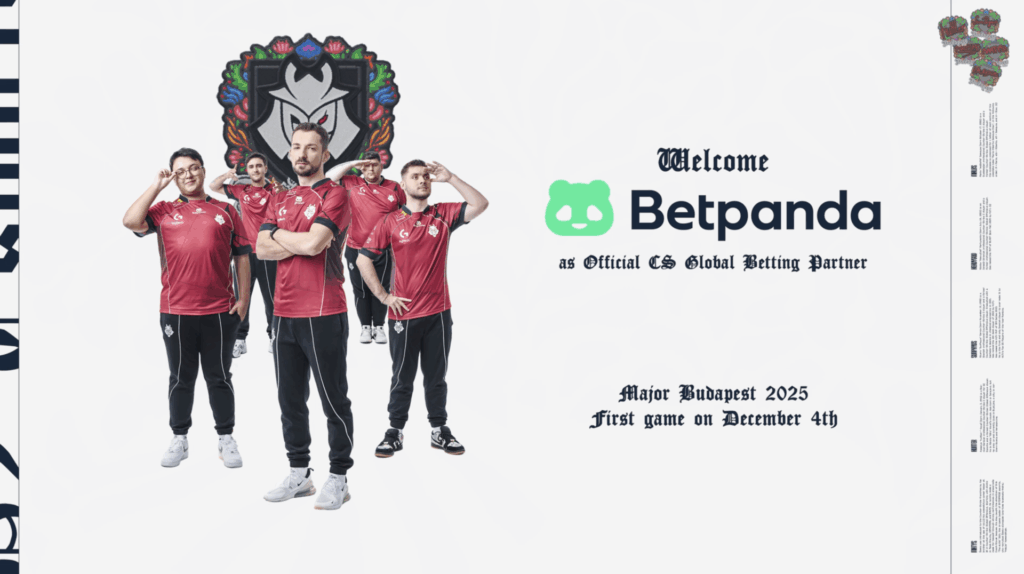
The year featured a lot of big esports betting partnerships, with Counter-Strike 2 one of the main games, in part due to its large betting volume and worldwide tournament schedule.
In December 2025, G2 Esports signed a momentous agreement with Betpanda. The agreement allows Betpanda to have the branding on G2’s CS2 team jerseys, social media platforms, and live stream graphics.
Team Vitality secured a long-term deal with Stake in July 2025. The agreement had Stake’s odds and promotional content becoming a natural part of Team Vitality’s broadcasts and player, generated content.
GamerLegion partnered with Leon Bet in October 2025. With this arrangement, the sportsbook collaborated on a range of exclusive content and new activations
Tournament organisers were also active in the scene. PGL, for instance, signed a two-year agreement with 1xBet in February 2025, making the latter the official betting partner for all of PGLs Counter-Strike 2 and Dota 2 events until the end of 2026. The BLAST Austin Major in June 2025 also featured 1xBet as its presenting sponsor.
StarLadder’s Budapest Major in November decided to have crypto-based casino Rollbit as its betting partner.
These deals, alongside many others across the esports ecosystem, continue to highlight the prominence of betting in the esports industry, both commercially and as a consumer product.
The post The biggest esports betting stories of 2025 appeared first on Esports Insider.